Showing posts with label creative writing. Show all posts

Monday, 18 May 2020

NEW WRITERS - WHAT TO LEAVE OUT OF YOUR STORY

TOO MUCH? OR TOO LITTLE?


If you're new to writing, the danger is more often to write too much rather than too little. It makes no difference whether you're writing a 90,000 word novel or a 1000 word short story: unnecesssary detail, information or dialogue will slow down, irritate, distract or bore the reader. So here are some points to keep in mind.

DIALOGUE: We all discuss the weather, or what we ate last night, or how our offspring is doing at school, but none of these things is relevant, UNLESS IT AFFECTS THE PLOT, eg the weather hints at a forthcoming hurricane which will then prevent our main character taking a ferry to Spain, or the prospective bridegroom ate a couple of dead mussels that night and therefore won't make the wedding, or our offspring will be arrested for burning down the school lab, which will explain why Dad goes on one drinking binge too many and Mum packs a suitcase, which therefore explains .. ..... It's all about consequences. So, cut out the small talk. Dialogue should sound natural, but every word should advance the story.

CHARACTER INFORMATION: Some creative writing books recommend you write a cv for each of your main characters so that you know them inside out. This isn't my way but lots of authors do it. But however you build and get to know your characters, do you need to download it all for your readers? Ration the details you pass on, you might be surprised how few you need to explain how someone behaves, reacts, emotes.

SETTINGS: A friend of mine happened to spend a lot of time in an exotic setting. He decided to make it the setting for his first novel, and while there he amassed notebooks full of information - about the place, the people, the economics, the history, etc, etc. Sadly he put so much of it in his novel that it became virtually unreadable. It's tempting to include all that you've learned, but you have to resist. From all those notebooks try to extract the essence of a place. A few well-chosen snippets slipped in here and there will usually do the trick.

I could go on and on - but then, I don't want to bore you!

Sunday, 17 May 2020

WRITING YOUR FIRST CHAPTER


Dialogue always looks good on the first page, doesn’t it? Two characters plunging into the story. Plenty of white space. Exclamation marks!

But you don’t have to start at the beginning of the conversation. The small talk, the explanations. Start in the middle, where the drama begins.


‘You’re leaving me?’
‘I’m sorry, I -’
‘Who is she?’
‘You don’t know her.’
‘It’s not that new secretary, is it?’
He shook his head. ‘You’ve never met her. She’s … someone from the past.’

Ah! The first clue!

Or, in a crime novel, start with the murder. Your reader doesn’t know who the victim is, or even the murderer. All that will come later.

How about a waking up scene? Your character opens their eyes. They’re in bed/in a locked cellar/buried under masonry/on an operating table/ sprawled alongside a wrecked plane, the pilot and his mate hanging out of the cockpit.

Drama! Mystery! Suspense! Explanations can come later, maybe not until the final chapter.

Saturday, 10 February 2018

TAKE THREE OLDIES

WHO'S DESCRIBING THE CHARACTERS IN YOUR BOOK?

The way an author describes a character can depends very much on the viewpoint character. A child, a younger adult, a contemporary, each will see/hear/note different aspects. Here are three examples.


TOMMY, AGED 5, MEETING HIS GRANDFATHER FOR THE FIRST TIME:
He thought Grampa looked interesting. He looked like a nice apple, small and round and rosy, and his hair was white and wispy. The top of his head shone through like pink china. His eyebrows were very thick and bushy and when he saw Tommy watching him, he wriggled them like caterpillars. For a moment he looked quite fierce but then he held out his arms and smiled. THE FAMILY ON PINEAPPLE ISLAND)

THIRTY-ISH MANAGER OF A RETIREMENT HOME, DESCRIBING ONE OF THE RESIDENTS:
Art is Patrick's thing. In his room he paints exquisite miniature watercolours of miniature birds - wrens, robins, blue tits. You'd never suspect it to look at him, such a large man, over six feet tall and heavily built. A plain man with a florid boozy complexion and coarse red hair now faded to the colour of stale cornflakes. It's always struck me as odd that he should choose to paint such tiny pictures. (ME, DINGO AND SIBELIUS)

Sometimes a mix of dialogue and action work well.
ELEVEN YEAR OLD DANNY AND HIS MOTHER'S SEVENTY-ISH CLEANER:
Up on the first floor I can hear Mrs Maggs, our cleaner, thumping her broom against skirting boards, bellowing out 'Land of Hope and Glory'. Nobody tells her to be quiet, even though it's only half past eight in the morning. I think they're all afraid of her. She appears at the top of the stairs with a cardboard box full of cleaning cloths and brushes. She is wearing fuzzy pink slippers with holes cut out for her bunions.
'What you doin' there?' she asks me.
'Waiting for my Uncle Frank.'
'Hmmph!' She shuffles down, muttering something about persons who have nothing better to do than sit on the stairs getting in other persons' ways and swipes a damp smelly cloth across my face as she passes.
She pulls a duster from her overall pocket and glares at the life sized statue of Mercury beside the front door.
'Some persons,' she grumbles, 'don't know they're born! Some persons just don't know when they're well off, living in one of the best mansions in Bristol, full of statues and stained glass, instead of a Council flat in St Pauls with compensation running down the walls. It's all right for some,' she grumbles, 'but what about them that has to work? Eh?' (THERE'S A LION IN MY BED!)

Saturday, 2 December 2017

MORE ABOUT CHARACTERS

MAKE READERS CARE ABOUT YOUR CHARACTERS

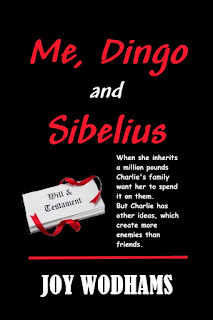
The book I believe is my best writing has a large cast of characters, ranging from baby Daisy, who looks like Harry Hill without the spectacles, to the various old people who inhabit Sundowners Retirement Home. Plot is important but if readers don't relate to the characters and care what happens to them, why bother? Here are three from ME, DINGO AND SIBELIUS: Charlie, my main character, a 30-something 'ugly duckling' who inherits a fortune and buys a retirement home, and two of the residents, Jenny and Freddie.

Here's Charlie herself: We went to Alma da Cuba, an amazing place, converted from a church. It has this incredible lighting, the alter glowing scarlet and blue, lights everywhere like huge candles, and a mezzanine restaurant above the bar and dance floor. It was gobsmackingly beautiful and I was as gobsmacked as anyone else, until I'd stood around for an hour or more, pretending to admire the architecture, snapping my fingers to the music, making fake calls on my phone. Playing wallflower. After that I escaped to the restaurant and ordered something laced with chillies. I blamed the chillies for my tears, but that was just an excuse I made to the waiter.

Jenny: "I'm such a silly idiot. Scared of my own shadow, my husband used to say. But - I can't help it, I can't - "
I knew Jenny's story. Abused for years by a lout of a husband, who'd recognised from the start a woman he could dominate completely. Jenny must have been a beauty in her youth, even now there's still the shadow of that beauty. But she also bears the marks of that violent relationship. Old breaks. Scars. A malformed cheekbone. There were no children. She had become pregnant once and her husband had punched it out of her. The only good thing he'd ever done was to leave her a reasonable fortune when he died, so that she could find a haven for her remaining years.

And finally Freddie: Freddie was a bank manager in the days when bank managers were always available and happy to be of assistance. He wore sober suits, crisp white shirts and his old school tie, and only his closest associates knew that he was a cross dresser. Even his wife had been unaware until the morning she found him posing before her dressing table in an eau de nil silk Teddy and a pair of her best ten denier tights, at which point she had selected a solicitor from Yellow Pages and commenced divorce proceedings.

Believe it or not, there's a happy ending for two of these three characters. The third - well, I had to have some tragedy, otherwise I might be writing for Mills & Boon!

ME, DINGO AND SIBELIUS is one of my books available on Amazon, and I will be donating all my royalties from October, November and December sales to our local hospital's Radiotherapy Unit Appeal and my local church's repair fund.
Happy Christmas, everyone!

Thursday, 12 October 2017

HOW TO WRITE FICTION

A NEW GUIDE FOR BEGINNERS

Having now published ten novels, I decided to take a break from fiction writing and put together all my teaching material from nearly three decades as a creative writing tutor.

The result is How to write FICTION, which you can now buy on Amazon as a Kindle e-book for £1.29.

It's full of guidelines and encouragement for beginners, and covers everything from how and where to find ideas, creating characters that come to life, and planning and plotting to get yourself organised so you don't lose the plot!

I hope you enjoy it.


Monday, 17 July 2017

WHAT IS A SHORT STORY?

HERE'S A DEFINITION

A short story can be anything from 500 (flash fiction) to 10,000 words, although the most popular length (for short story competitions, etc) is 1500 to 1700 words.

The short story is usually restricted to a single theme, a single mood, a single conflict, a single incident, a single episode in a character's life, a moment that changes someone's life or attitude in some way. It doesn't necessarily have a beginning, a middle and an end. Sometimes it can be circular, but usually something changes, something is resolved, the main character is affected in some way.

There should be few characters, and usually just a single viewpoint, past or present tense.
There's no room for waffling, wordiness or over-long description.
Every word counts, every action is significant.
It should leave the reader feeling entertained, mystified, amused, thoughtful, disturbed, pleased or sad but, in one way or another, satisfied. Ideally, it should remain in the reader's mind for at least as long as it takes to read. A bit like a good poem, really.
Although it's short, that doesn't mean it's easy to write. In fact, it can be quite a challenge.
Here's a circular example, one of mine (THE GOOD NEIGHBOURS OF ROWAN CRESCENT)
The residents of Rowan Crescent are very similar, successful husband, fashionable wife not needing to go out to work, 2.4 children etc. They live in each other's pockets, holding regular parties hosted by each couple in turn, babysitting for each other, sharing their woes and their triumphs. Perfect neighbours with perfect lifestyles.
Until one husband abandons his wife for his secretary. At first the abandoned wife's friends are full of sympathy and offers of help. Their husbands rush to repair her washing machine when it breaks down, fix her roof, mow her lawn etc., the wives shop for her when she has to go back to work, and of course she is still invited to all the parties. But gradually the wives begin to complain and criticise. Their husbands are far too eager to help the forsaken neighbour, it's a nuisance looking after her children so frequently, and it can be awkward having odd numbers at dinner parties etc. Soon they cease to invite her, and it's not long before she is ignored.

Eventually she sells the house and moves away with her children. A new couple with 2.4 children move in. They are welcomed with open arms and offers of help by their good neighbours and the cycle begins again. (About 2500 words)

Thursday, 8 June 2017

HOW TO INTRODUCE CONFLICT IN YOUR NOVEL

Here's a story:

Jess was a very pretty baby. Everyone admired her. As she grew, she made many friends. At school she was always top of the class. She left university with an excellent degree. She got a well-paid and interesting job and rose to become a director of the company. She married her childhood sweetheart who loved her to bits and they had two beautiful perfect children, who also did well at school and were perfectly sweet and well-behaved. They had a perfect house which never needed repairs, a car that never broke down. Nobody had a moment's illness. The story ends with Jess and her husband celebrating their silver wedding, surrounded by loving family and friends.
A good story? Interesting? NO!
All the way through such a story you're waiting (hoping!) for the Big Foot Up There to stamp down on them and disrupt their perfect life.
You can't sustain interest in a story or novel without introducing some form of CONFLICT, something to upset the status quo. It can take any number of forms. Here are some of them:
Another character, or characters, who is jealous, envious, hostile, more ambitious, unfaithful, dishonest.
A health problem, a crippling accident - to your main character or a loved one.
Loss of wealth, loss of job, loss of home, loss of a loved one.
External events - a terrorist attack, a murderer on the loose, floods, storms, war.
These are just a few suggestions.
Whichever you choose (one or several) your story will then show how your main character struggles with, and hopefully overcomes, the problem(s), becomes stronger and regains that perfect life.
A much more interesting story.
It doesn't have to be melodramatic. Here's a very simple and homely example:
Two newly-weds move into their first home, a ramshackle cottage on the outskirts of a village. They renovate it and live happily ever after. Where's the conflict?
a) Husband falls through the bedroom floor and breaks a leg
b) They find the cottage has dry rot and they have to move back in with Mum and Dad while it's being sorted - and while husband's leg is in plaster.
c) There's Japanese knotweed in the garden
d) Their planning application is turned down and they have to rejig it.
e) The work goes on and on and they become so exhausted they begin to squabble.
And so on, and so on.

This can be a warm and funny story, and the reader expects and knows there'll be a happy ending, but it's how your character(s) struggle with and overcome conflict and problems that will hold their interest to the end.

Friday, 15 April 2016

FROM SHORT STORY TO NOVEL

WHAT IS A SHORT STORY? AND CAN YOU TURN IT INTO A NOVEL?


You can't just define it by the number of words. In my anthology THE FLOATER the shortest short story is 513 words, the longest nearly 5000. The accepted maximum is around 10,000 words. Beyond that it becomes wearisome - unless you add several more elements and turn it into a novel.
Because the chief difference between a short story and a novel is that a story covers a single event, a single experience, a single incident or a single revelation. There are few characters, not much conflict and no sub-plots.
But although a short story has fewer words, it's not necessarily easier to write. It's a bit like composing a poem. Every words must count, must have significance. As for the endings! Ah, that can be the hardest task of all. An open ending? A closed ending? All the loose ends tied up? A full circle back to the beginning?

Here's my shortest story, A HICCUP IN TIME:
It took Dodwell six months to build the time machine. He had ordered it in kit form from Taiwan and the manual, translated into a quaint form of English, had severely taxed his limited knowledge of electronics.
His first trip had been a near disaster, catapulting him into his own bed some twenty years in the future.It had been disconcerting to find himself lying beside an older Dodwell and disappointing to find that his strict diet of sheep’s milk, yoghurt and oranges had not preserved him from thinning hair and a paunch. He would have liked to enquire further after his future health, but the older Dodwell’s bulging eyes evinced such terror that he had thought it best to mutter a quick “Sorry” and beat it for the door.
A pity about the little blonde who had dived beneath the sheets. Had he been able to stay longer he might have discovered her identity but at least he had something good to look forward to.
For the time being he would concentrate on his main interest: the great artists and performers of the past whose autographs he so desired to collect. The time machine was the instrument through which he would meet them in the flesh.
His second journey went only slightly awry. Whilst he had focussed on 1901 and the playwright George Bernard Shaw he arrived instead in 1999, face to face with Melvyn Bragg, a writer whose work still received occasional mention in the more comprehensive Literary Companions of Dodswell’s own time. Bragg had been pathetically pleased to give his autograph to a 22nd century time traveller and Dodwell had managed to sell it on for a few Euros on his return.
Since then he had met many of his idols and rarely received a rebuff. Jane Austen had been amiable and courteous, Emily Bronte abrupt and a little puzzled. Nijinsky had taken some pinning down and of course there had been the language problem, but Pavlova, Caruso, Mark Twain, Laurence Olivier, Graham Norton – Dodwell now had them all.
Inevitably however the time machine failed, three days after its guarantee expired. It happened in London’s West End where Dodwell had popped in to see the 2013 production of The Book of Mormon.
No amount of twiddling or kicking would restart the machine, and in despair Dodwell was forced to retreat into its cabin, later suffering the indignity of being clamped.
Trapped in time, Dodwell prayed for deliverance but as the weeks went by he decided it wasn’t such a bad life. Most people were friendly. Those who had initially regarded him with suspicion decided he was harmless enough and began to bring him food, blankets, the Daily Mirror.
He became a fixture in the West End landscape, even meriting an article in the Telegraph Sunday Magazine. On fine days Japanese tourists surrounded him with their digital cameras, posing alongside his machine. Some asked him to pose with them. He always said yes. It gave him some amusement to picture the bewilderment on their faces when they saw the empty spaces on their photographs.

Now, could you turn this into a full length novel?
You'd have to add complications. Obstacles. More characters. An ongoing conflict or situation which is resolved at the end.
Perhaps Dodwell is not the only time traveller who's ended up in London in the year 2013. In this case the short story, perhaps minus the last few paragraphs, becomes the first chapter of a novel in which the two travellers meet up, struggle to find a solution to the problem, maybe fall in love if this is going to be a romantic fantasy, and live happily ever after as a tourist attraction.
Another alternative is that Dodwell - alone or with the proposed second traveller - decides to abandon his time machine, settle down in Bognor Regis and use his knowledge of the future to make a fortune and become Mayor.
Of course, the short story could become the final chapter. Perhaps Dodwell has an enemy in the 22nd century who wants to get rid of him and has programmed the time machine to expire in Leicester Square a hundred and fifty years in the past.

The possibilities are endless.

Thursday, 14 April 2016

CREATING REAL, FLAWED CHARACTERS

Heroines Don't Have To Be Beautiful, Blonde and Boring

The journey of a plain girl through your novel can be far more interesting. In my latest novel, ME, DINGO AND SIBELIUS,  my heroine Charlie has become more lovable and more alive with each chapter. I'm really very fond of her and felt sad when I finally put her to bed! Perhaps I'll write a sequel one day.

Here's the first chapter. I hope you like it. 

It's Monday. And it starts like any other Monday.
Mum downstairs cremating breakfast. My sister Georgie and my niece Rosie screaming at each other in Rosie's bedroom. My other niece, Daisy, screaming for her morning bottle. The kitchen radio blasting out the Chris Evans Show. And me, grumpy because my hair drier, the only one in the house that still works, is missing.
Looking into the mirror I see my Dad. As usual. With the hair drier I might at least move up a notch or two on the charm scale.
'OK, who's got it?' I yell.
Of course, I already know. Rosie, who spends hours each morning creating elaborate hairstyles to impress her schoolmates. Is it worth marching into her bedroom and trying to claim it? I've tried that before and it's come down to a physical fight for possession which Rosie usually wins. It's surprising how strong a skinny twelve year old can be.
Right now her quarrel with Georgie is escalating. I can hear them through the thin wall.
'I don't care what the others wear, Rosie, you're NOT going to school in six inch heels! Apart from the fact that you'll probably break an ankle, you look ridiculous.'
'Everybody's wearing them, I'll be the odd one out.'
'I'm sure they're not. And you can take off those false eyelashes, too. They're mine, aren't they? For heaven's sake, you're twelve, Rosie.'
'And ten months. Practically a teenager!' Rosie's sobbing increases in volume, but it's not going to soften Georgie's heart.
Who'd be a Mum? Me, I admit. But fat chance now. Thirty two already and only one proposal to chalk up. Jason Fishlock, former handyman at the Sundowners Retirement Home. Clammy hands and a noticeable squint. He must have thought he was in with a chance, being that I wasn't likely to attract anyone else.
Pausing only to give my bird's nest curls one last despairing comb through, I grab my rucksack and run downstairs.
In the kitchen Mum, a vision of cool elegant efficiency, is stirring something vigorously in a large pan. A stranger watching her might assume she knew what she was doing, despite the scatter of eggshells on the floor, leaving slimy trails of albumen across the tiles. Once upon a time Georgie reigned in the kitchen, but that was in the days when she still had dreams of owning her own restaurant. Nowadays, leaving out Mum's occasional urge to cook breakfast, our family's diet consists primarily of tins, packets, takeaways and pizzas, unless I have a day off and I'm prepared to cook a meal from scratch. The irony is that the others appear to thrive on it. I'm the only one who ever gets zits or stomach ache or lank hair.
'I'm making scrambled egg,' says Mum.
'I guessed.'
She turns the pan upside down. 'Hmm. Seems to have set solid. Still, shame to waste it. Want some?'
'Just toast for me, Mum. I'm having lunch out.'
Her eyes turn bright with hope. 'Anywhere nice? Who are you going with?'
'British Home Stores, and Alice Howell. We're taking the residents on a shopping trip.'
'Still. You never know who you might see while you're out. You should wear that nice green jacket I got you from the charity shop.'
Yeah. The one that makes me look like a leprechaun's kid sister.
'Give up, Mum. I'm not likely to meet Mr Right in BHS or anywhere else. I'm past my sell by date and I look like – like - '
'You look very nice, love.'
Nice. Not beautiful. Not even pretty. Just – nice.
'If you'd do something with your hair, and maybe a bit of make-up?'
'It's no use. I'm never going to look like you or Georgie. I look like my Dad.'
'Your Dad was a very handsome man, God bless him.'
But handsome in a man equals plain, or at most, passable, in a woman.
No one else in the family has inherited Dad's genes. The hair, uncontrollable without half a pot of gel and half an hour of blow drying. The snub nose and wide mouth. The golden brown eyes that practically disappear when I smile. The lack of height.
Georgie and Rosie have blue eyes and slender figures like Mum. They also have Mum's long golden locks, like Rapunzel in the fairy stories. It's too soon to tell with Daisy, only ten weeks old and still bald as a coot. At the moment she looks like Harry Hill without the spectacles but no doubt she'll metamorphose into something blonde, slim and elegant like the rest of the Churchill clan.
I walk past the hall mirror without bothering to look. What's the use? I'm stuck with what I am. The ugly duckling. The runt of the litter. The one that's nearly but not quite.

And if I don't set off now, I'm going to be late for work.

Monday, 29 February 2016

WHAT CAN I WRITE ABOUT? - PART TWO

MORE WAYS TO FIND IDEAS

The bible is a never ending source of ideas. Conflict, love, war, domination, betrayal, sin, faith, temptation - how about a modern day Judas? A team of young men spreading the word about - what? A man - or woman - resisting temptation to give up or give in?
Take an emotional situation - bereavement, illness, homelessness, infidelity, envy - apply this to your main character and see what happens.
Just another handful of starting points for your short story or novel!


How about fairy stories? Hansel and Gretel? Jack climbing the ladder (of success) and finding a hostile giant at the top? Rapunzel locked in her tower - perhaps a young woman locked away in an attic. Update the characters, change the setting and you're away!

Think of a location - a prison,  a retirement home, a school, a hospital. What sort of characters will you find there, and what will they be up to?

Tuesday, 23 February 2016

WHAT CAN I WRITE ABOUT?

IS YOUR BRAIN EMPTY OF NEW IDEAS? PICK UP A NEWSPAPER!

If you're a writer and you're suddenly needing new inspiration, check out your local or national newspapers.

Not the inch high headlines but the small paragraphs that  are hoarded by editors to be used as fillers on their pages.

Odd, intriguing, funny or just plain weird, they're a wonderful storehouse of starting points for short story writers or novelists. 

Here are a few which I've keyed into my IDEAS file :

A FRENCH HUNTER HAS HAD HIS RIGHT HAND AMPUTATED AFTER BEING SHOT BY HIS DOG WHILE DEER HUNTING

BELGIAN WOMAN SETS OUT TO DRIVE 38 MILES TO BRUSSELS USING HER SATNAV,  ARRIVES IN THE CROATIAN CAPITAL ZAGREB 2 DAYS AND 901 MILES LATER.

PUB LANDLORD FINDS DEAD BODY OF REGULAR CUSTOMER IN THE GENTS' LAVATORY. FEARING THE POLICE WOULD CLOSE THE PUB FOR INVESTIGATIONS, HE HIDES THE BODY IN ONE OF THE PUB'S BEDROOMS FOR 4 DAYS.

AMERICAN FARMER EATEN BY OWN PIGS - here's one for the horror fiction writers. ALL THAT'S FOUND IS HIS SET OF FALSE TEETH.

COMA MOTHER LOSES 13 YEARS OF MEMORIES.

MOTHER RUNS BROTHEL TO PAY FOR CHILDREN'S SCHOOL FEES.

These are all genuine reports - mainly from my regular English  newspaper, THE DAILY TELEGRAPH.

And here's my own favourite, possibly my next project:|

WOMAN LEAVES NOTICE ON DOOR OF HER ANTIQUE SHOP - 'BACK IN 2 MINUTES'. THIRTY  YEARS LATER SHE STILL HASN'T RETURNED.


Tuesday, 2 February 2016

WRITING - IT'S ALL IN THE MIND!

If you're feeling bored and frustrated, with nothing to do except go to work, clean house, cook dinner, feed the offspring, feed the cat, walk the dog, weed the garden, mow the lawn, check the bank statement, watch Match of the Day or The Great British Bake Off, perhaps you need a new interest.


So, assuming you enjoy reading and managed to stay awake through at least a few English language classes at school, why not become an author? Writing fiction - creating fictional people, putting them into scary or crazy situations - is FUN, and a long long way from writing an essay on 'What I did during the summer holidays'.

Perhaps there's no risk of your becoming the new Stephen King, Katie Fforde or J K Rowling, but hey, who needs money? And no one's saying it's not hard work, but the enormous, amazing, fantastic pleasure is in creating a world from inside your brain that's totally different from anyone else's.

So, why not have a go? It's easier - and harder - than you think!

Tuesday, 22 September 2015

HOW NOT TO CONSTRUCT A NOVEL

It's almost a year since I started writing about Charlie Churchill, ugly duckling in a dysfunctional scatty family of beautiful females. At that time the book was called THE SITTING TENANT. Here's my blog from last October:

"Charlie's a carer in an old people's home where Dingo, 89, a diabetic who's lost both legs and has failing eyesight, becomes her closest friend. When he dies Charlie discovers he's bequeathed her his entire estate: an enormous dog (Irish Wolfhound), an enormous sum of money and an enormous house with an embittered sitting tenant, a former soldier in Afghanistan who's also a double amputee.
After writing 6000 words I  decided it wasn't going anywhere.
So .... Keep the family - they're funny and colourful and I could have a lot of fun with them. Keep Mum's on-off toy boy, Ricky Capaldi, keep Arsehole Alan. Keep Dingo, even though he dies in Chapter 2. Keep the dog. Keep the sitting tenant but give him back one of his legs (another double amputee is too much of a coincidence).
4000 words later it still doesn't work.
So .... Keep the family. Dump the dog. Dump the tenant. Dump the house. Keep the money. Introduce a sexy lawyer. Introduce a writing class with a creepy would-be crime writer. Change the title from THE SITTING TENANT to THE WRITING CLASS.
7000 words on, where am I going? Who knows? Nobody said writing was easy, but it's fun!"
Since then, the only constant has been Charlie herself.
The writing class has vanished, the title is now ME, DINGO AND SIBELIUS, and Charlie has now bought the home for the elderly. Oh, and the sexy lawyer is still hovering. Sibelius? No, that's not the Irish Wolfhound.
At last I think I'm on the right track, plenty of conflict and colourful characters and I'm past the 40,000 words mark.
All these changes have added months to my writing schedule and I've ignored all the sensible rules of plotting and planning, but it's still the greatest fun I know!

Saturday, 5 September 2015

WHEN TO BREAK THE RULES OF WRITING

SOMETIMES YOU JUST HAVE TO USE A MIRROR!

Most of us writers try to avoid the use of a mirror in describing a character's appearance. Too hackneyed, the sign of a poor writer, unimaginative, we're told. In fact, it's almost a rule.
But occasionally, as in my current book (working title: ME, DINGO AND SIBELIUS) it seems like the best, most effective way.
Charlie, the main character, is the 'ugly duckling' in a family of beautiful females. Now 32, she's the only one who resembles her beloved Dad, who drowned when she was 16 and whom she still grieves for.
In describing her as she glares at her reflection in the hall mirror, I'm therefore describing two people, Charlie and her father. As the book is written in the first person, I'm also trying to convey her frustration and despair that she is the odd one out, the one who's ignored, the one who's still a virgin.
Here's the relevant section:
In the hall mirror I glare at my reflection in disgust. No one else in the family has inherited Dad's genes. The hair, uncontrollable without half a pot of gel and half an hour of blow drying. The snub nose and wide mouth. The golden brown eyes that practically disappear when I smile. The lack of height.
Georgie and Rosie have blue eyes and slender figures like Mum. They also have Mum's long golden locks, like Rapunzel in the fairy stories It's too soon to tell with Daisy, only ten weeks old and still bald as a coot. At the moment she looks like Harry Hill without the spectacles but no doubt she'll metamorphose into something blonde, slim and elegant like the rest of the Churchill clan.
I turn away from the mirror. What's the use? I'm stuck with what I am. The ugly duckling. The runt of the litter. The one that's nearly but not quite.
I'm always conscious of potential criticism but sometimes it just feels right to ignore the rules.


Saturday, 28 February 2015

YOU LEARN SOMETHING NEW EVERY DAY!


I spent a lot of time online the other day searching for personal experiences of working on sheep or cattle stations in the Australian Outback. I wanted this info for my latest book - the one that started off with an elderly amputee, a younger amputee invalided home from Afghanistan, a dog, a disfunctional family in Liverpool and a writing class, all of which have been ditched except for number one and number four.
(See my post NOBODY SAID IT WAS EASY from 13 October)

Why did I want to know about Australian livestock stations? Don't ask, I may well change the story yet again by next week.
In any case, I couldn't find what I wanted, so I decided to download a novel that I hoped would give me what I need.
I now know all I didn't need to know about the mechanics of gay sex but all I've learned about the Outback is that there's a lot of red dust.


Saturday, 23 August 2014

USING ALL THE FIVE SENSES


Bring the settings of your story or novel to life by using as many senses as possible. Three examples below.


A LEAFY STREET IN A WEALTHY SUBURB
The street dreams in the sleepy afternoon sun. The great oaks and sycamores that shadow the manicured  lawns are still. Not a leaf trembles, not a bird stirs to search for food or to send a message to its neighbours. High above the roofs of the houses an aeroplane travels slowly across the haze blue sky, so high it cannot be heard. A piano tinkles in a room somewhere. A dog barks half heartedly. It is three o'clock and the street waits. For the children to race each other home from school. For the husbands to motor back from the City. For the houses to shake themselves awake after their afternoon nap.

URBAN SLUM - 1930'S
The street was almost empty. Head down, Jenny plodded stolidly towards the corner, eyes focussed on the stained and spotted pavements. Midday meals were being eaten behind net curtains, and the odours of fish and liver and frying fat and sausages fought each other down the long row of terraced houses. A greeting came from Mrs Fiskett, who was down on her knees scrubbing her front step. Her flowered pinny had soaked up the grey soapy water and her hands were reddened, almost raw. 

A NEGLECTED GARDEN
Years ago when the gardens were regularly tended they must have been beautiful, but now, like the house, they were abandoned and unkempt. Here and there the sweeping curve of a flower bed showed beneath the burgeoning weeds and in odd corners a few lank daisies struggled upwards through the summer strong nettles, but the unpruned roses were already gaunt and leafless, and ivy had strangled the gnarled old trees. Kathy ploughed through the orchard, unseen rotting apples squelching beneath her feet. The long grass billowed in damp hummocks around her legs.

Thursday, 14 August 2014

HOW TO WRITE EXCRUCIATING LITERATURE


A short lesson on how to improve(?) your writing skills.

When writing dialogue, don't use 'he said', 'she said'. There are so many wonderful alternatives:
'Help me,' she screeched. 'That's funny,' she giggled. 'My God!' he ejaculated. 'Is it raining?' he enquired. 'Come here!' he demanded. 'Go away!' he shouted.
Most published writers use 'he said' or perhaps 'he asked' most of the time, but it's nice to be different, isn't it?

What about adverbs? Lovely, aren't they? And they add to your word count. Here are some examples of tautology (ie saying the same thing twice over):
He hissed sibilantly, she laughed merrily, he shouted loudly, she ran quickly, he ambled slowly. 
Well, some readers are a bit thick, aren't they? They need that extra explanation.

What about word length? Naturally you want readers to appreciate your literary skills, and short simple words won't do it, will they?
So get out that Thesaurus and look up as many multi-syllabic options as you can. And while you're at it, why not scrap those short pithy sentences for longer, more comnplicated ones?

There! Isn't that better? Your 1500-word short story is now 3000 words (and totally unreadable).

Thursday, 24 July 2014

WRITING 'REAL' DIALOGUE

'Real' dialogue in a story is NOT the same as dialogue in real life: So the first thing to do is to cut out all the Umms and Errs, all the Hellos and Goodbyes, discussions about the weather, etc. Then look at what's left and see how you can use it to reveal something about a) the characters, b) the plot, c) their relationship.

When someone reads a book, they see every word or sentence as having significance.

For instance, if a character says. 'I see they're having a sale at M&S tomorrow', the reader will think, Perhaps there's going to be a bombing there tomorrow, 200 killed, and maybe Tracey (the viewpoint character) will rescue the store manager and be offered a job in the next chapter as Chief Buyer!

Instead of which, there's just the usual boring Sale, or it's never mentioned again by any of the characters, and the reader wonders why it was ever mentioned in the first place!

So cut out all unnecessary information and use dialogue ONLY to advance the story in some way.

However, written dialogue should read - and sound - natural. Listen to those around you. People don't use whole carefully structured sentences, the exception possibly being politicians! In real life and in books people use half sentences, broken phrases. They interrupt each other. They interrupt themselves. They often finish each other's sentences.


Monday, 21 July 2014

FIRST DRAFT, FIFTH DRAFT - WHY BOTHER REVISING


However amazing your plot, however vital your characters, however seductive your setting, if your story/novel is poorly written it will be rejected.

So  revise, revise and revise again. Is your beginning attention-grabbing? Does your plot meander? Are there long periods of
nothing much happening?
What about superfluous adjectives, adverbs? Over-long descriptions? Telling, not showing?

What about the time scale? Have you allowed sufficient days, months or years for the action to take place?


I could go on forever, but why not make your own checklist? 
Here's a page from one of my own novels after a first time rewrite -, but not the last.